
Project Title: Middleware Synchronisation and Data Migration Between SMT Equipment Providers
Client: EMS Manufacturer (“ClientTech”)
Technology Providers:
- PROVIDER_A: Hanwha SMT Equipment and MES database (Microsoft SQL Server)
- PROVIDER_B: Mycronic SMT Storage Systems and Traceability database (PostgreSQL)
Keywords: Middleware Integration, SMT Synchronisation, EMS Middleware Solution, MSSQL-PostgreSQL Bridge, Real-Time Production Synchronisation, Factory Automation, SMT Equipment Integration, Python Middleware Development, SMT Manufacturing Software, Industry 4.0 Integration, Data Migration, Factory Data Migration Solutions
1. Project Background
ClientTech operates a high-mix, medium-volume electronic manufacturing service (EMS) facility. Two principal vendors provided SMT equipment and storage solutions, resulting in fragmented production data.
Challenge: Real-time synchronisation and efficient data migration between PROVIDER_A (Hanwha MSSQL Server) and PROVIDER_B (Mycronic PostgreSQL) systems were lacking, leading to manual interventions, data mismatches, and operational inefficiencies.
Objective: Develop a fully automated, future-proof middleware that synchronises and migrates production data seamlessly, thereby enhancing production tracking accuracy and digitalisation.
2. Objectives
- Enable near-real-time data synchronisation (polling every minute).
- Establish bi-directional data flow for component registration and consumption updates.
- Migrate reel, carrier, and stock information accurately between systems.
- Minimise manual operations and error-prone reconciliations.
- Prepare for future deployment in containerised (Docker) environments.
3. Solution Overview
A bespoke Python middleware service was developed to bridge PROVIDER_A’s Hanwha MSSQL Server and PROVIDER_B’s Mycronic PostgreSQL database via Web Services.
Key Features:
- Real-time polling of storage system APIs.
- Database view reading and stored procedure calls for updates.
- Structured error handling and comprehensive logging.
- Modular, scalable architecture ready for containerisation.
- Seamless data migration of legacy records during initialisation.
4. System Architecture
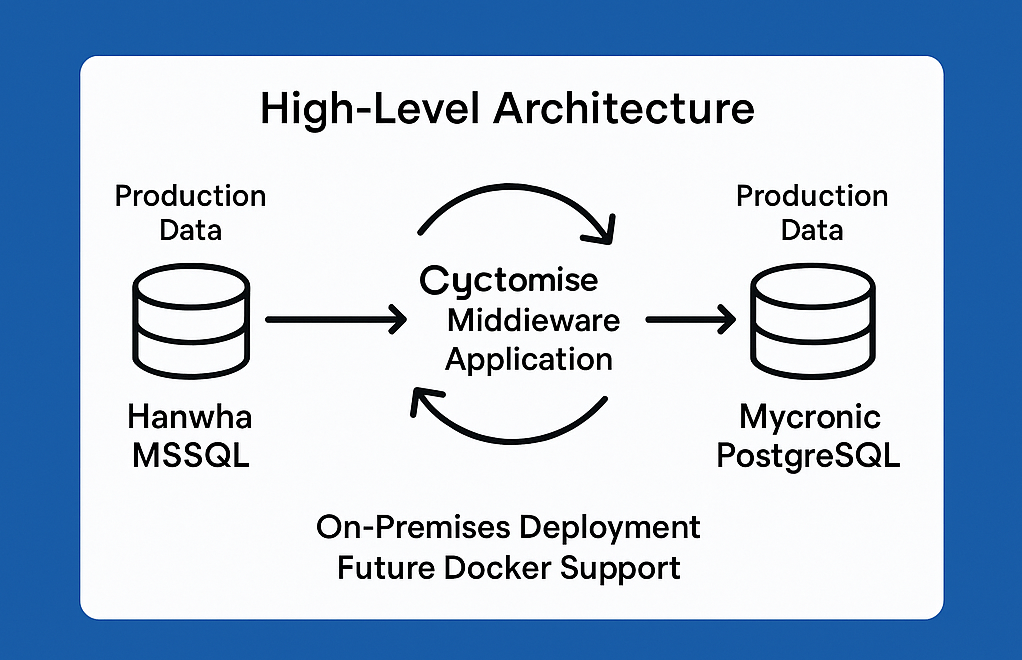
PROVIDER_A (Hanwha MSSQL Database) <--> Python Middleware Service <--> PROVIDER_B (Mycronic PostgreSQL WebService API)
Components:
- Database Connectors (pyodbc for MSSQL, psycopg2 for PostgreSQL)
- XML WebService API Client
- Data Mapper for field translation
- Core Synchronisation Engine
- Retry and Logging Mechanism
- Optional REST API endpoints for manual operations
High-Level Architecture Diagram:

5. Sample Python Project Structure
middleware/
├── config/
│   ├── settings.yaml
│   └── logging.conf
├── connectors/
│   ├── mssql_connector.py
│   ├── postgres_connector.py
│   ├── webservice_client.py
├── core/
│   ├── sync_engine.py
│   ├── data_mapper.py
│   ├── error_handler.py
├── api/
│   ├── server.py
│   └── routes/sync_routes.py
├── utils/
│   ├── xml_utils.py
│   ├── service_utils.py
├── logs/
│   └── middleware.log
├── tests/
│   ├── test_sync_engine.py
│   ├── test_connectors.py
│   └── test_mapper.py
├── main.py
├── README.md
└── requirements.txt
6. Implementation Details
Development Stack:
- Python 3.11
- Libraries: requests, lxml, pyodbc, psycopg2, apscheduler
- Security: SSL/TLS API communication, encrypted credential storage
Middleware Functionalities:
- Poll PROVIDER_B (Mycronic WebService) every 60 seconds for updated component data.
- Insert or update reels and carrier data during the migration process.
- Push new reel/component information into PROVIDER_B when registered in PROVIDER_A.
- Update reel quantities back into PROVIDER_A upon unload events from PROVIDER_B.
- Log all operations and errors with automatic retries.
7. Testing Strategy
- Unit Testing: Each component tested independently.
- Integration Testing: Mocked databases and APIs used.
- System Testing: Full validation against production data.
- Validation Scenarios: Successful migration, synchronisation, and failure recovery.
8. Deployment Approach
Initial Deployment:
- Native Python service installed on ClientTech’s on-premises servers.
Future Roadmap:
- Prepare Dockerfile and docker-compose templates for containerisation.
9. Results
- Synchronisation success rate: >99.9% in the production environment.
- Manual interventions reduced by 85%.
- Real-time production and material visibility achieved.
- Legacy data fully migrated and validated.
- Foundation laid for scalable Industry 4.0 transformations.
10. Lessons Learned
- Proper timeout configurations are crucial for heavy database loads.
- Field mapping precision is critical for successful data migration.
- Dead Letter Queue design proved vital for resilience.
11. Conclusion
ClientTech successfully implemented a robust, scalable middleware and data migration solution, ensuring real-time synchronisation between SMT systems and significantly improving production efficiency and data integrity.
Date: April 2025