
Structured Data Governance for Scalable Organizations
As data ecosystems grow, complexity increases. Multiple systems, evolving KPIs, departmental reporting variations, and expanding analytics initiatives create fragmentation.
Without structured governance, metrics drift, definitions diverge, and decision-making loses consistency.
Our Data Governance & Enterprise Modeling services focus on building structural control frameworks that ensure data integrity, metric alignment, and long-term organizational clarity.
Governance is not about restriction.
It is about consistency, traceability, and decision reliability.
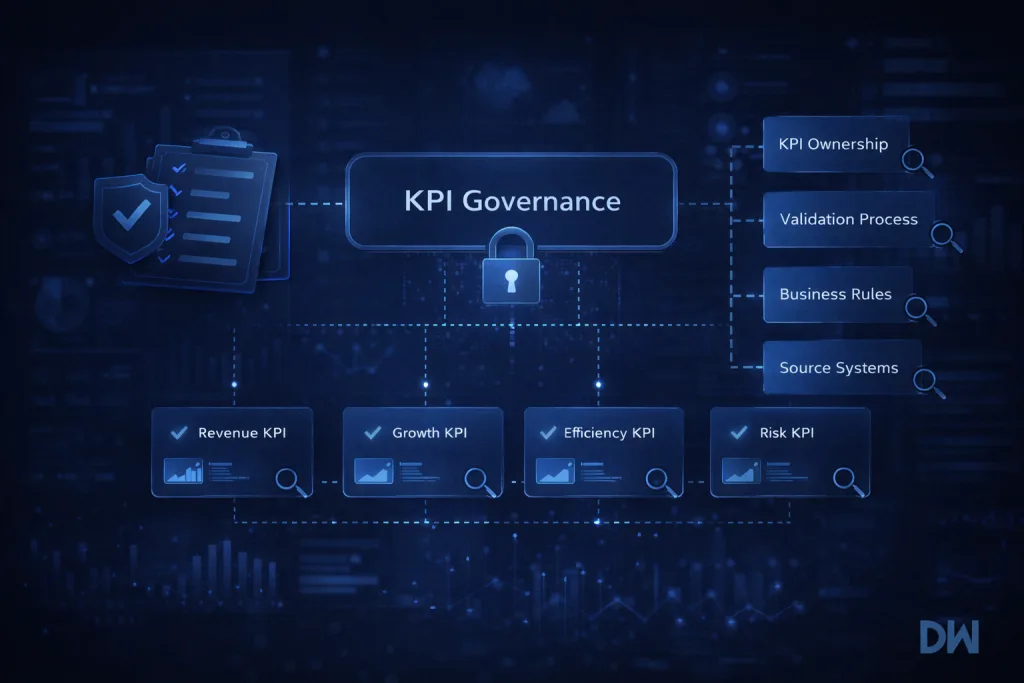
KPI Governance & Business Rule Formalization
Metric inconsistencies rarely originate in dashboards. They originate in undocumented logic.
We formalize business rules and KPI definitions before implementation, ensuring:
- Clear ownership of metrics
- Documented calculation logic
- Consistent aggregation rules
- Structured validation processes
- Cross-system alignment
This prevents reporting conflicts and ensures executive decisions are based on consistent interpretations of performance data.
Enterprise Data Modeling & Semantic Architecture
Enterprise modeling is the structural foundation of scalable analytics.
We design logical and physical data models aligned with:
- KPI frameworks
- Reporting hierarchies
- Organizational structures
- Governance standards
Semantic layers are engineered to ensure that business definitions remain consistent across Power BI, cloud platforms, and analytics environments.
Data modeling is not theoretical documentation.
It is the architecture that protects analytical coherence.
Data Validation & Organizational Alignment
Governance cannot exist in isolation.
We conduct structured data validation workshops to reconcile inconsistencies, align stakeholders, and validate metric definitions before system-wide deployment.
This ensures:
- Controlled reporting transitions
- Reduced metric disputes
- Transparent business logic
- Organizational alignment around performance indicators
Governance becomes embedded in operational processes, not layered afterward.
Traceability & Decision Integrity
Structured governance frameworks ensure that every KPI, report, and dashboard element can be traced back to:
- Source systems
- Transformation logic
- Business rules
- Ownership responsibilities
This traceability protects decision integrity and strengthens executive confidence in analytical outputs.
Who This Service Is For
This service is designed for organizations that:
- Experience inconsistent KPI interpretations
- Lack documented business rule frameworks
- Operate across multiple reporting systems
- Require structured enterprise modeling
- Seek long-term governance stability
Why Governance & Modeling Matter
Without structured governance:
- Reporting becomes politically driven
- KPI definitions evolve informally
- Analytical systems diverge
- Organizational trust in data weakens
Data governance and enterprise modeling are not administrative layers.
They are structural safeguards for scalable decision-making.