
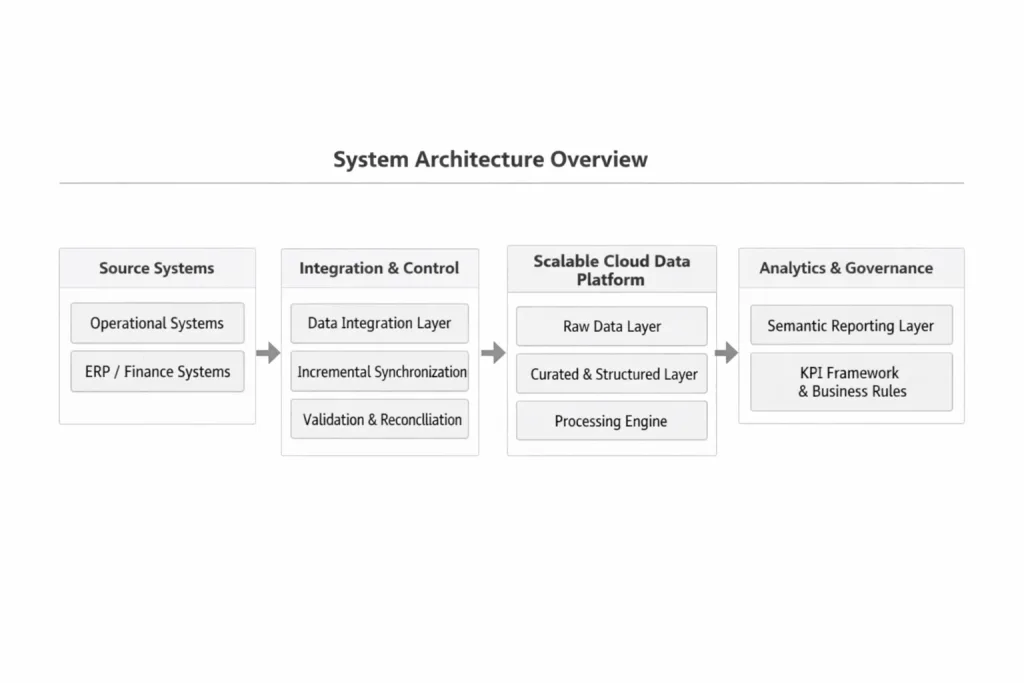
A mid-sized industrial organization operated multiple operational and financial systems across separate PostgreSQL and Microsoft SQL Server environments.
Production data, ERP data, and reporting systems were maintained independently. Over time, reporting logic diverged between departments, KPI definitions lacked formal documentation, and manual reconciliation became part of the monthly reporting cycle.
The organization required a structured migration and synchronization strategy that would:
- Consolidate data environments
- Eliminate manual reconciliation
- Standardize KPI logic
- Maintain operational continuity
Challenge
The primary risks identified were structural rather than technical.
- Cross-system inconsistencies between PostgreSQL and SQL Server databases
- Manual reconciliation processes delaying reporting cycles
- KPI definitions lacking ownership and documentation
- Risk of downtime during migration
- No scalable architecture prepared for future cloud expansion
The organization needed an architecture-led intervention, not a dashboard redesign.
Technical Intervention
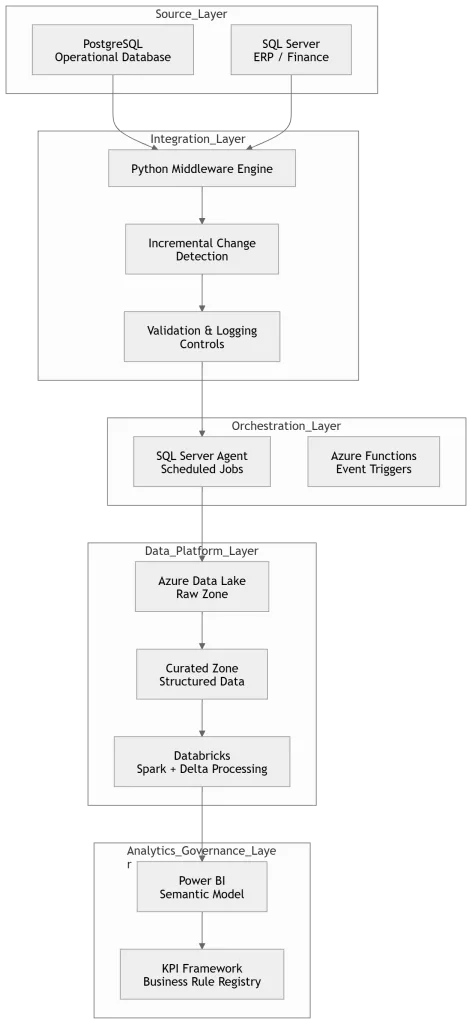
DataWiz designed and implemented a layered migration and synchronization architecture focused on incremental control and governance alignment.
System Landscape
- PostgreSQL (Operational Database Layer)
- SQL Server (ERP / Financial Systems)
- On-premise infrastructure
- Power BI reporting environment
Architecture Strategy
Instead of a full system replacement, a phased migration model was implemented.
The architecture included:
- Full schema mapping and data type normalization
- Domain and composite type restructuring
- Incremental synchronization logic based on timestamp and primary key comparison
- Python-based middleware for controlled data transfer
- Transaction-level validation and reconciliation checkpoints
- Structured logging and idempotent execution design
Orchestration was managed using:
- SQL Server Agent (scheduled jobs)
- Python service-based execution
- Optional Azure Functions for event-based extensions
Cloud expansion capability was embedded into the architecture:
- Azure Data Lake Storage (raw and curated zones)
- Azure Event Hubs (event streaming readiness)
- Azure Cosmos DB (structured staging when required)
- Databricks for scalable Spark-based processing
- Delta architecture for reliable data versioning
The migration was executed in controlled phases, including parallel validation runs and rollback contingencies.
Zero downtime was achieved.
Governance & KPI Alignment
Technical consolidation alone would not resolve reporting fragmentation.
A governance framework was implemented alongside the migration:
- Formal KPI definition documentation
- Business rule registry
- Department-level validation workshops
- Structured semantic alignment in Power BI models
- Defined data ownership responsibilities
- Reconciliation approval checkpoints
This ensured that KPI logic was preserved and standardized across systems before executive reporting deployment.
Architecture Snapshot
The final architecture operated across five structured layers:
Source Systems
PostgreSQL (Operational Data)
SQL Server (ERP / Finance)
Integration Layer
Python Middleware Engine
Incremental Change Detection (CDC Logic)
Data Transformation & Validation Rules
Structured Logging
Orchestration Layer
SQL Server Agent
Python Job Services
Azure Functions (Event-Based Extensions)
Cloud & Processing Layer
Azure Data Lake Storage
Azure Event Hubs
Azure Cosmos DB
Databricks (Spark + Delta Processing)
Analytics & Governance Layer
Power BI Semantic Models
KPI Framework Documentation
Business Rule Registry
Validation & Reconciliation Controls
Results
Within three months of implementation:
- Manual reconciliation processes were eliminated
- Reporting cycle time reduced by approximately 40%
- KPI definitions standardized across business units
- Executive reporting consistency significantly improved
- Hybrid-ready cloud architecture established
- Migration completed without operational disruption
The organization transitioned from reactive reporting practices to structured performance governance.
Key Insight
Data migration without governance produces temporary alignment.
Governance without engineering produces structural fragility.
Sustainable analytics requires both architectural control and business rule discipline.